November 7, 2026 · Updated November 8, 2026 · 7 min read
How to repurpose one reel for LinkedIn, X, Threads and your blog
Copying one post to every platform reads like copying. Keeping the facts fixed and changing the angle for each channel does not.
Forrester’s predictions for 2027, published on 30 October, say the lifespan of content created for influence will shrink to 30 days. In the same report, the analysts predict that human-generated content becomes a top priority again for half of brands.
If each post has about a month to work, writing every one from scratch for every channel is more than a team of one can keep up with.
To repurpose one reel for several channels, keep the facts and sources fixed and change the angle and the format for each channel. A feature for your blog, a news-style post for LinkedIn, a thread for X or Threads and a short item for your newsletter can all come from the same checked material.
Why change the angle instead of copying the post?
Each channel is read differently, and readers notice a pasted post. In an r/SocialMediaMarketing thread, someone asked how to turn one video into a week of posts without it feeling copy-pasted. Replies suggested giving each post its own angle, changing the format for the platform, and batching the work right after recording.
An angle is a decision about what the piece is for. One version leads with the money, another with what to do on Monday, a third with an argument. None of them needs new facts.
What stays the same on every channel?
The claims and their sources. Check them once, and every version inherits the check. That is also what keeps a week of posts consistent: when the LinkedIn post and the blog post cite the same pages, they start from the same facts.
StrandScribe checks each claim once and reuses the kept sources for every article you write from the reel.
See how a claim gets checkedWhich format suits which channel?
Your blog, on WordPress or Ghost, is where the full feature or news article goes, with every source listed. It is the page you own and the one search engines and AI assistants can quote at length.
LinkedIn suits a shorter news-style post or an opinion piece that leads with the consequence for the reader’s work. DEV and Hashnode suit the same article when the reel is technical.
X and Threads suit a thread: one claim per post, each with its source. Threads gives you more room than it used to. Meta’s April 2026 update to the Threads API added text attachments of up to 10,000 characters.
A newsletter takes a short item: what the reel claimed, what the sources say, and a link to the full post.
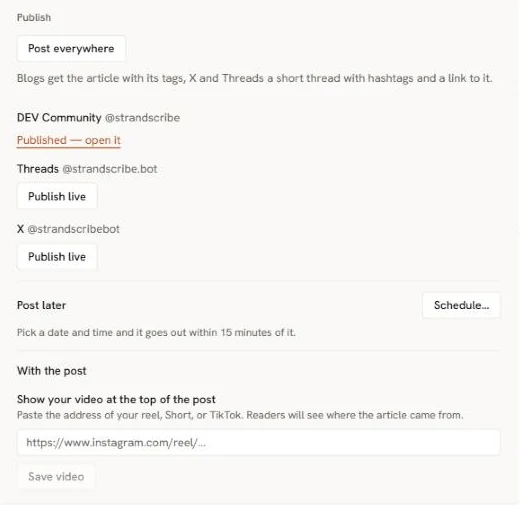
In StrandScribe, Post everywhere sends one article to every account you have connected, in the shape each one expects. Blogs get the full article with its tags. X and Threads get a short thread with hashtags and a link back to the article. A connected LinkedIn account posts the article as one post on your profile, with a link to the full article when it has been published elsewhere.
How do you keep the week from repeating itself?
Write the blog post first, because it holds everything. Then write each other version from the sources rather than from the blog post, with its own lead. Schedule them across the week rather than publishing them in one burst, so each one gets its own day.
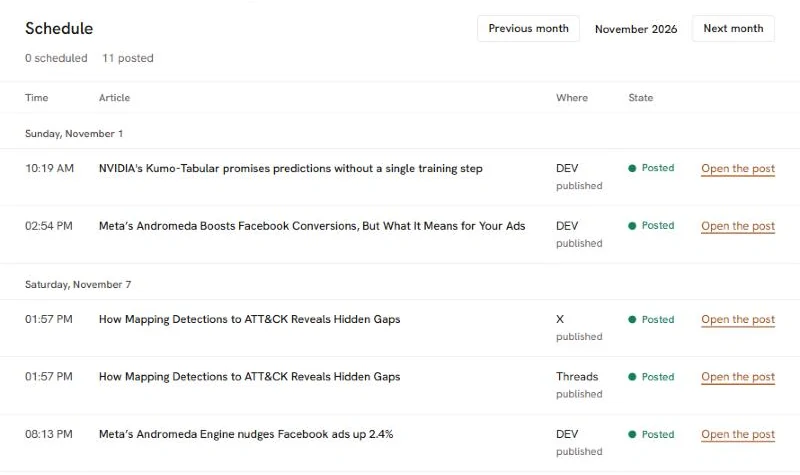
Post later takes a date and a time, and the post goes out within 15 minutes of it. The Schedule page then lists every post by day, with the platform and whether it went out.
Which accounts can you connect?
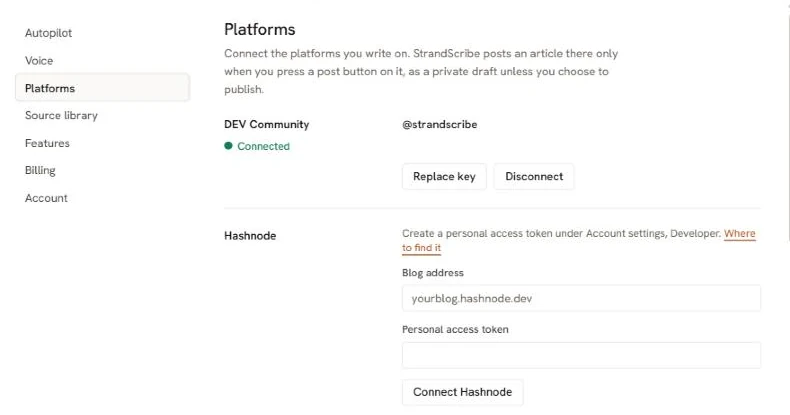
Seven, and they connect in two ways. Blogs take a key you create on the blog itself: an application password for a self-hosted WordPress site (version 5.6 or newer), an Admin API key from a Ghost custom integration, a personal access token for Hashnode, and an API key for DEV. X, Threads and LinkedIn use their own sign-in instead, and LinkedIn asks you to sign in again every sixty days.
Medium, Substack and WordPress.com do not offer key-based posting, so they are not on the list. For those, download the article as Markdown and paste it in by hand.
Can this run without you?
Mostly. In StrandScribe, each reel you share becomes one brief with one set of checked sources. You can write the news angle as a LinkedIn post and the practical angle as a blog feature, and both stay side by side under the same brief. The format menu has eight entries: news article, evidence review, feature, opinion piece, newsletter issue, LinkedIn post, thread for X and short caption. Posting covers WordPress, Ghost, DEV, Hashnode, X, Threads and LinkedIn.
With Autopilot on, each reel is researched and written without you opening the site, then saved as a draft or published, as you choose. If no trustworthy source is found, nothing is written and the brief waits for you.
Share one reel and write it two ways.
Try it with your next reelIf you already post the same reel to three platforms and stop there, checked sources and an angle per channel are what the posts are missing. Starter is €9 or $10 a month for 50 reels; Pro is €29 or $30 for 250; Agency is €199 or $200 for 2,000.
Both plans include scheduling and Autopilot.
See plans and pricingQuestions people ask
How do you repurpose a video for LinkedIn?
Keep the video’s checked facts and sources, and write a shorter post that leads with the consequence for the reader’s work, as a news item or an opinion piece. Link to the full article on your own blog.
Should you post the same content on every platform?
Use the same facts, not the same post. Change the angle and the format for each channel so each version reads as if it was written for that place.
How long can a Threads post be?
Meta’s April 2026 Threads API update added text attachments of up to 10,000 characters, with formatting.
Can StrandScribe post to several platforms from one reel?
Yes. One reel becomes one brief with one set of checked sources, and you can write several articles from it and post each to WordPress, Ghost, DEV, Hashnode, X, Threads or LinkedIn.