November 7, 2026 · Updated November 8, 2026 · 7 min read
How to fact-check AI-written content before you publish
Since October, Google’s own guide says every piece of AI-generated content should be checked by a person before it goes live. Here is a checklist that holds up, claim by claim.
On 1 October 2026, Google added one sentence to its Search Central guide on using generative AI content: it is critical to manually fact-check and review all AI-generated content for accuracy and trustworthiness before publishing. The same edit widened that review to the title, the meta description, structured data and image alt text.
PPC Land, which reported the change the next day, noted that it came with no new penalty or ranking signal. It is guidance. Google also wrote down its reason: generative models predict likely sequences of words rather than look facts up, so what they produce can contain inaccuracies.
To fact-check AI-written content, list every checkable claim in the draft, find a page that states each one, confirm the supporting passage is on that page word for word, and cut whatever you cannot source.
Why does AI-written content need checking at all?
Readers already doubt it. Forrester’s predictions for 2027, published on 30 October, report that only 18 percent of US online adults trust information provided by AI. The Reuters Institute’s 2026 Digital News Report, a survey of almost 100,000 people in 48 markets, put trust in news answers from AI chatbots at 20 percent.
What counts as a claim?
Any sentence that could be true or false: a number, a date, a name, a quotation, a cause (“the update led to the drop”), a comparison or a superlative. Opinions and advice are not claims, but the facts they lean on are.
Include the title and the meta description. Google’s updated guide names them because they are what appears in search results, and often in AI answers, before anyone opens the page.
How do you fact-check an AI draft, step by step?
First, list the claims. Copy every checkable statement into a list, one per line, including the ones in the headline and the description.
Second, find where each claim comes from, not a page that happens to agree with it. Prefer the primary source: the study, the filing, the official help page, the company’s own announcement. A blog post that repeats a number is a lead, in the same way a reel is.
Third, open the page and find the passage. Search the page text for the sentence that carries the claim. If it is not on the page you opened, you have a link, not a source.
This is the step StrandScribe does for you. A source is kept only when its passage is found word for word on the page that was fetched.
See how a claim gets checkedFourth, compare the details with the passage: the number and its unit, the date, who said it, and any condition attached. Watch for small shifts, such as a forecast reported as a result, 12 percent becoming 21, or a 2025 study described as new.
Fifth, decide. If the passage supports the claim, keep it. If it supports a weaker version, write the weaker version. If nothing supports it, delete the sentence.
Sixth, record the source beside the sentence, with the publisher’s name and the date. A reader can check a named, dated source, and it is the kind of specific an AI assistant can quote.
Why does the passage have to match word for word?
Because every looser test lets something through. A summary can drift from what the page says. A paraphrase can change a “may” into a “will”. A model can produce a quotation nobody wrote, and a page can change after it was first read.
Requiring the exact passage on the fetched page removes all of those at once, and it is cheap to check with find-in-page. It does not prove the page is right. It proves the page says it, which leaves you one judgement to make: whether you trust the publisher.
What if a source disputes the claim?
Keep it. A page that contradicts the claim is as useful as one that supports it, and sometimes more. Write what the sources say, including the disagreement, or drop the point if the disagreement is the whole story and you have no way to settle it.
Can a tool do the checking for you?
Part of it. StrandScribe starts from a reel you share with @strandscribe.bot on Instagram. It transcribes what is said, reduces it to the checkable claims, searches for each one and reads every page it finds. A source survives only when its passage is on the page. Sources that dispute a claim are kept and shown too, and a claim with no source is left out of the article. You can add a source of your own.
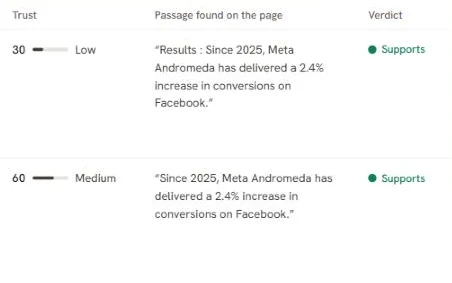
Read the trust score as closely as the verdict. In the screenshot above, the same sentence about a 2.4 percent rise in Facebook conversions was found on two Meta pages. The engineering blog scored 60, medium trust. A Meta for Business page scored 30, low. The score rates the publisher and how many independent sites say the same thing, and the product labels it a guide, not proof that a page is right.
The draft is written to state as fact only what a kept passage says, with each factual sentence numbered to its source. That gives your review a starting point: a sentence without a number has no source behind it, so read those first and cut any you cannot source yourself. Posts to your blog are created as private drafts unless you choose to publish. Google asks for a human review, and the tool is built to make that review short.
Have a reel that makes a claim worth checking? Share it and get a sourced draft back.
Try it with your next reelIf you publish one AI-assisted post a month, the six steps above and a browser are enough. If you turn video into writing every week, the checking is where the hours go. Starter costs €9 or $10 a month for 50 reels, Pro €29 or $30 for 250, and Agency €199 or $200 for 2,000.
Both plans include every format, your own voice, scheduling and Autopilot.
See plans and pricingQuestions people ask
What did Google change about AI content on 1 October 2026?
Google added a sentence to its guide on using generative AI content saying it is critical to manually fact-check and review all AI-generated content for accuracy and trustworthiness before publishing. The review now also covers titles, meta descriptions, structured data and image alt text.
Does Google penalize AI-generated content?
Not for being AI-generated. Google’s 2023 guidance says appropriate use of AI or automation is not against its guidelines, while using it mainly to manipulate search rankings is spam. Its October 2026 update asks for a human fact-check before publishing.
Is a link to a source enough to back a claim?
No. A source counts only when the page you opened contains the passage that supports the claim. A link to a page that does not say it is a citation in name only.
Should I check the title and meta description too?
Yes. Google’s guide names title elements, meta descriptions, structured data and image alt text as content to review, because they can appear in search results.